Zhongnanhai
Government compound and former imperial garden in Beijing.
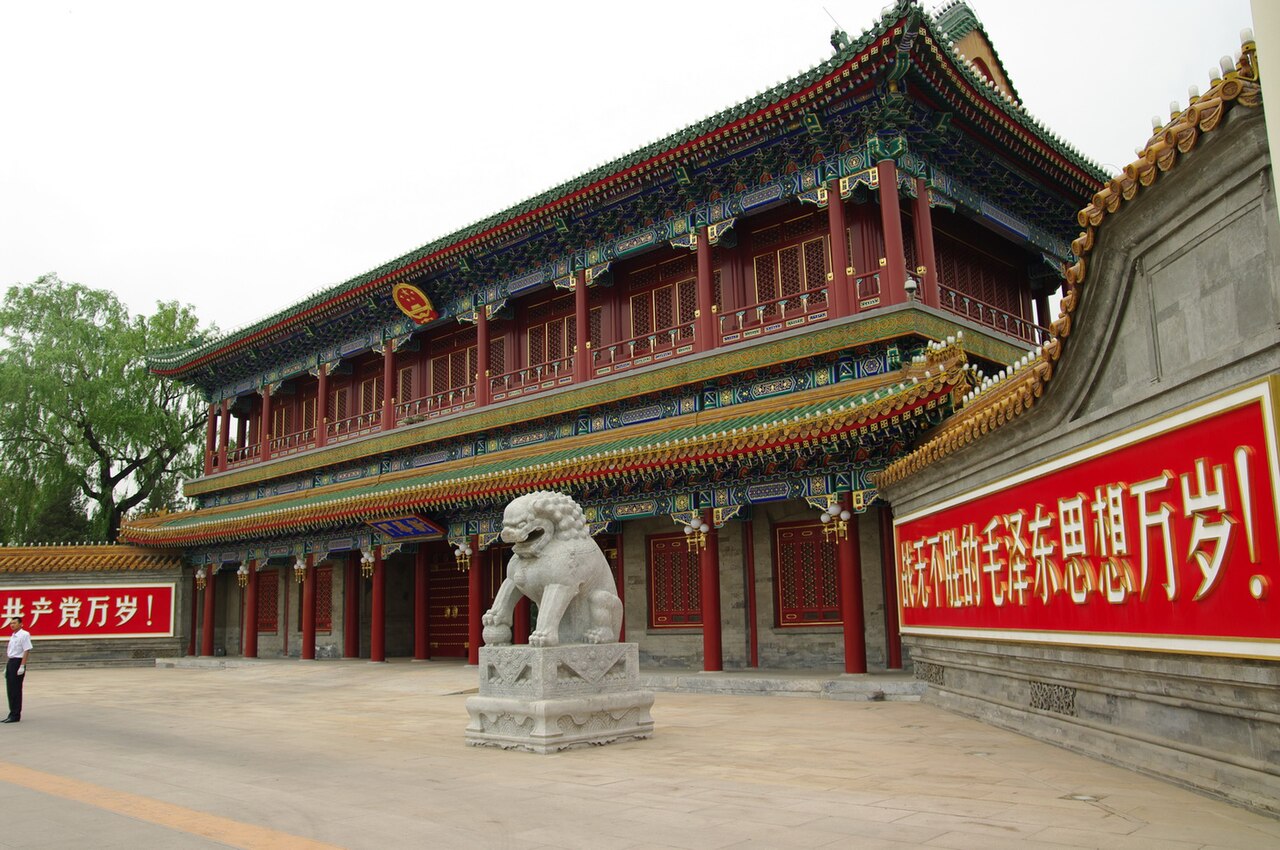
Zhongnanhai is a walled compound in Beijing that serves as both the workplace and residence for the top leaders of the Chinese Communist Party and the State Council. Originally an imperial garden, it sits next to the Forbidden City. The name “Zhongnanhai” is commonly used as a shorthand for China’s central government and its leadership.
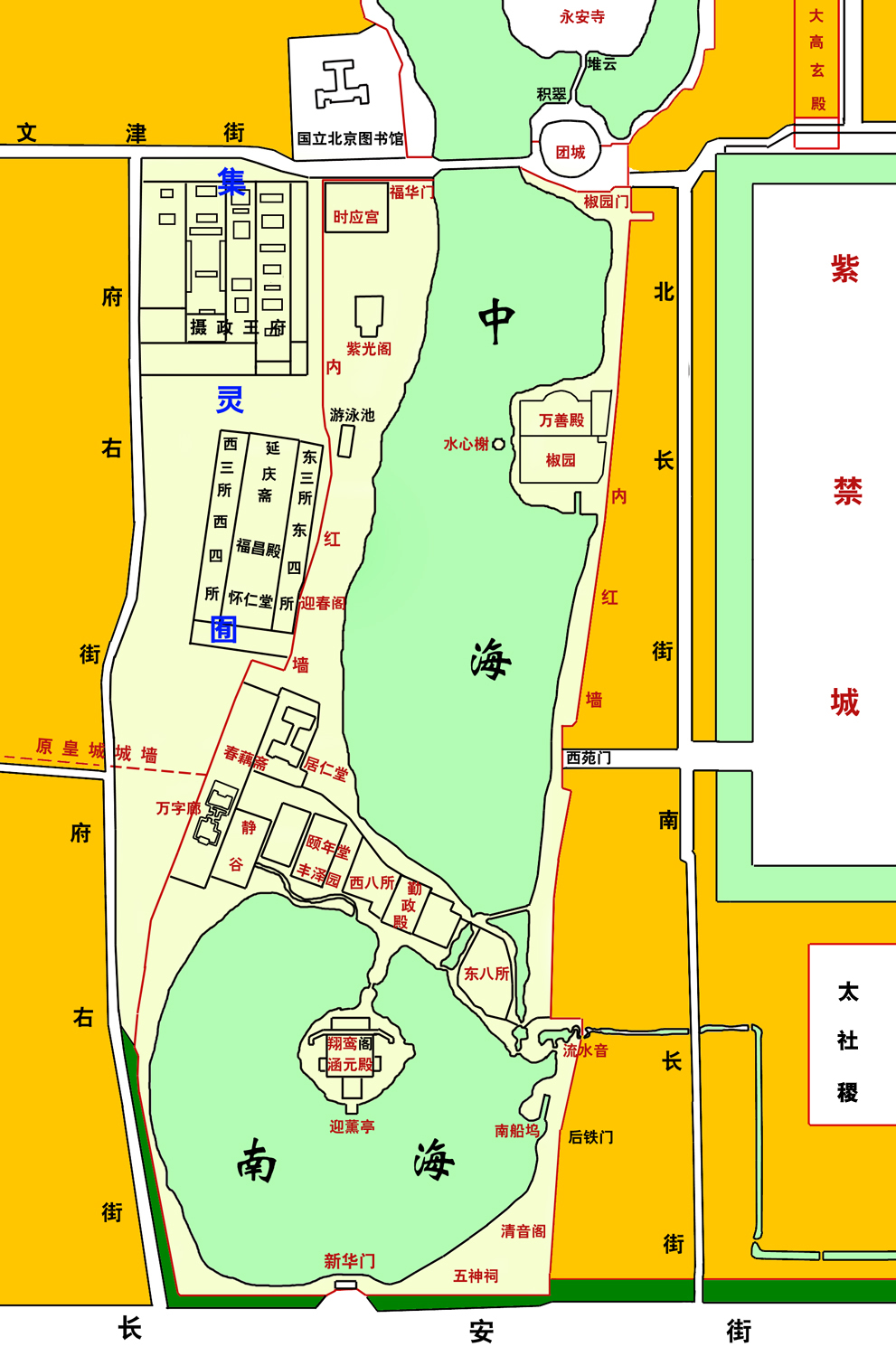
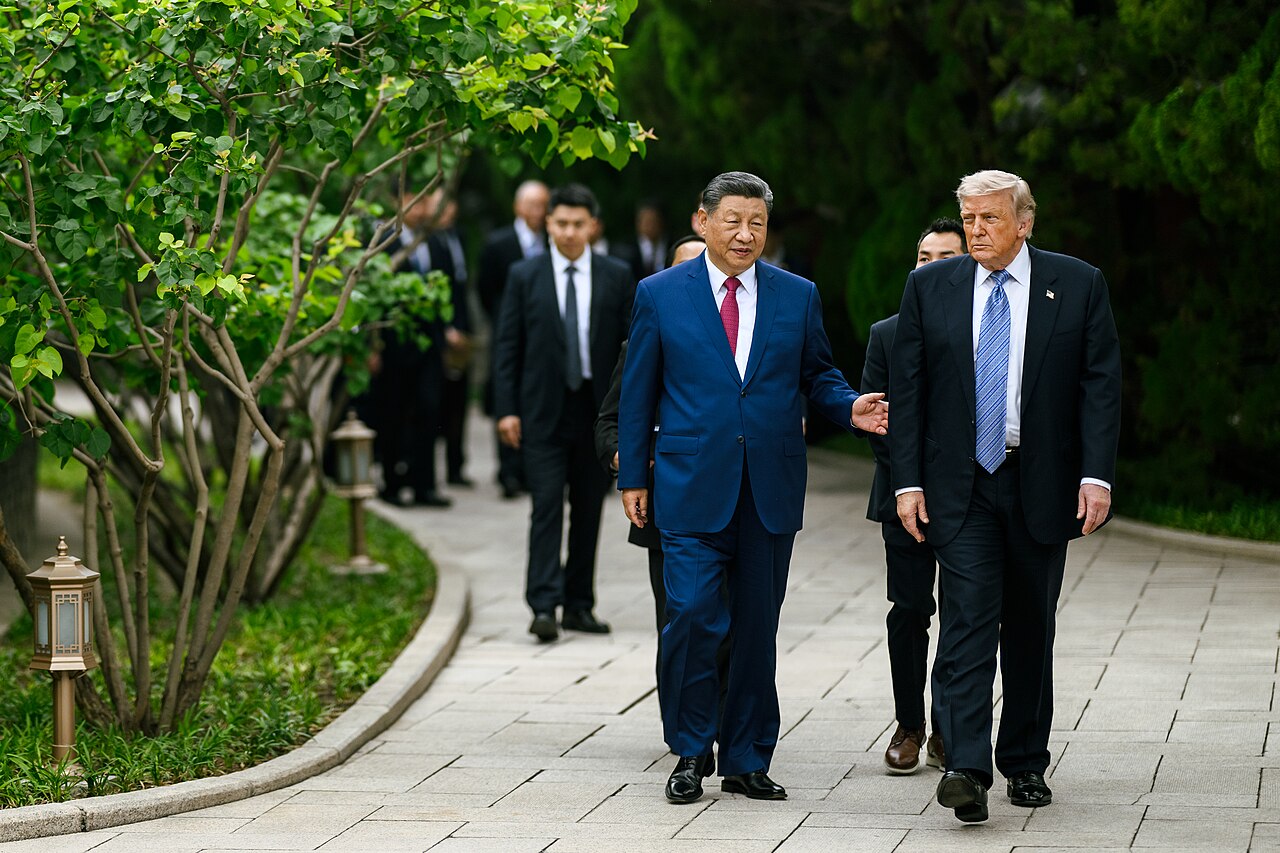
Inside the compound, the party’s general secretary, the paramount leader, and other senior officials handle daily administrative tasks, including meetings with foreign visitors. China Central Television often broadcasts footage of these meetings, but typically shows only the interiors of buildings. While maps of the complex existed before the People’s Republic was founded, the layout has been heavily altered since then, especially during a major renovation wave in the 1970s. Many buildings today share names with older, pre-1949 structures, but their layouts and functions have completely changed.
The compound is split into two main sections, reflecting the parallel authority of the highest state and party institutions. Northern Zhongnanhai houses the State Council’s headquarters, including offices for its most senior leaders and main meeting rooms. Southern Zhongnanhai is the headquarters of the CCP Central Committee, its staff, and its top coordinating bodies—the Standing Committee, the Politburo, and the Secretariat.
The basic shape of Zhongnanhai dates to the Ming dynasty, when the Yongle Emperor ordered the subdivision and reclamation of land around Taiye Lake to create a garden retreat. By the late Qing dynasty, it had become the de facto center of government: Empress Dowager Cixi and later Prince Regent Chun built residences there instead of in the Forbidden City. After the Republic of China was established, President Yuan Shikai remodeled the compound to serve as the formal center of the Beiyang Government. In late 1949, CCP Chairman Mao Zedong moved in after initially staying in the suburbs. He received many foreign leaders there, including Nikita Khrushchev, Che Guevara, Richard Nixon, Georges Pompidou, Kakuei Tanaka, and Zulfikar Ali Bhutto. Mao’s favorite spots were the Library of Chrysanthemum Fragrance—his personal residence, filled with bookshelves—and the Poolside House next to the large indoor swimming pool, where he would spend much of the day swimming or reading books and reports. After his death, the Chrysanthemum Library and many of his belongings were preserved as a museum, now closed to the public.
**Location**
The name “Zhongnanhai” means “Central and Southern Seas,” referring to two lakes within the compound: the Central Sea and the Southern Sea. It is sometimes translated as “Sea Palaces.” These two lakes were part of a series of projects during the construction of the Imperial City. The corresponding Northern Sea, or Beihai, to the north is now a public park. The three interconnected lakes—Northern, Central, and Southern—are collectively called Taiye Lake. Adjacent Shichahai connects to Beihai through Qianhai.
Taiye Lake originally formed the core of an imperial garden called Western Park (Xiyuan) or Western Court (Xinei), with parklands along the shores enclosed by a red wall in the western part of the Imperial City. Most of the pavilions, shrines, and temples survive from that period. While the Northern Sea had a religious focus, the shores of the Central and Southern Seas were dotted with worldly palaces.
**History**
During the Jin dynasty, Emperor Zhangzong built the northern lake in 1189. The northern section of Zhongnanhai was the original Taiye Lake, with an attached palace called the Palace of Great Peace (Daninggong). In the Yuan dynasty, Taiye Lake was included within the Imperial City and expanded to cover roughly the area of the Northern and Central Seas today. Three new palaces were built around the lake.
After the Ming dynasty moved its capital to Beijing in 1403, construction of the now-extant Imperial Palace began in 1406. The new Ming palace was built south of the Yuan dynastic palace, so a new Southern Sea was dug south of the existing lake. The excavated soil, along with that from the palace moat, was piled up to form Jingshan, a hill north of the Forbidden City. At that time, the three lakes were connected by channels and collectively called Taiye Lake, part of the extensive royal park Xiyuan, which stretched from the western wall of the Imperial City to the western wall of the Forbidden City. In the middle Ming period, the Zhengde and Jiajing emperors built many more palaces, Taoist temples, and pavilions around the lakes, spending more time there than in the Forbidden City.
After the Qing dynasty established its capital in Beijing, the government reduced Xiyuan’s size to the area centered on the three lakes, enclosed by a small wall—portions of which form the basis of Zhongnanhai’s current boundary. During the late Qing, several gatehouses were built on both sides of Jin’ao Yudong Bridge, giving Zhongnanhai and Beihai Park separate wall enclosures within Xiyuan. Successive Qing emperors built pavilions and houses along the lakeshores of Zhongnanhai.
- Location
- Adjacent to the Forbidden City, Beijing
- Type
- Government compound and former imperial garden
- Current Use
- Headquarters of the CCP Central Committee and State Council
- Historical Periods
- Ming dynasty to present
- Notable Resident
- Mao Zedong
Lore & Background
Zhongnanhai's basic outline emerged during the Ming dynasty when the Yongle Emperor subdivided land around Taiye Lake to create a garden retreat. By the late Qing dynasty, it became the de facto center of government, with Empress Dowager Cixi and Prince Regent Chun residing there. After the establishment of the Republic of China, President Yuan Shikai remodeled it as the formal center of the Beiyang Government, creating the current main gate, Xinhuamen. During the Boxer Rebellion, allied troops occupied and looted the compound. Mao's favorite places were the Library of Chrysanthemum Fragrance, his personal residence filled with bookshelves, and the Poolside House next to the indoor swimming pool. After Mao's death, the Chrysanthemum Library was preserved as a museum no longer accessible to the public. The compound is divided into two sections: Northern Zhongnanhai houses the State Council, while Southern Zhongnanhai is the headquarters of the CCP Central Committee, including its Standing Committee, Politburo, and Secretariat. The interior layout has been significantly altered since the founding of the People's Republic, including major renovations in the 1970s.
Reader's Guide
Zhongnanhai is significant as the enduring seat of political power in China, housing the top leadership of both the Chinese Communist Party and the State Council. Its history reflects the transition from imperial garden to republican presidential palace to communist party headquarters, symbolizing the continuity of centralized governance in Beijing. The compound's division into northern and southern sections mirrors the parallel authority of state and party institutions. Its use as a metonym for China's central government underscores its role as the locus of administrative and diplomatic activity, where leaders meet foreign dignitaries and conduct day-to-day affairs. The preservation of Mao's residence as a museum, though now closed to the public, highlights the compound's role in shaping modern Chinese history. Zhongnanhai remains a symbol of authority and a key site for understanding China's political structure and historical evolution.
Did You Know?
- The name 'Zhongnanhai' means 'Central and Southern Seas,' referring to two lakes within the compound.
- Mao Zedong's favorite places in Zhongnanhai were the Library of Chrysanthemum Fragrance and the Poolside House.
- The current main gate, Xinhuamen, was created by Yuan Shikai during the Republic of China period.
- During the Boxer Rebellion, allied troops occupied Zhongnanhai and looted almost all artifacts and decorations.
Design, Construction & Scale
Farrells initially produced the land-bid concept, after which Kohn Pedersen Fox took the helm and spent fourteen months refining the design before breaking soil. China Construction Third Engineering Bureau handled the physical build.
The 2018 Observatory Controversy
The rationale, as the report explained, was that on a clear day the entire Zhongnanhai complex, seat of the Central Committee and the State Council, could be seen with the naked eye from the tower's summit. More troublingly, observers noted that high-end telescopes and monitoring equipment could potentially reveal the daily routines of top Party and State leaders. In response, authorities ordered the building to be rectified, citing fire-safety issues, though CITIC Group declined to disclose the specific reason behind the directive. Reports further suggested that, once rectification was complete, the uppermost three floors would fall under the administrative control of National Security authorities, effectively removing them from the building's commercial programme.
The 2026 Plane Crash
Flight-tracking data from Flightradar24 showed the plane had entered restricted airspace inside Beijing's Fifth Ring Road and was approaching Zhongnanhai—a complete no-fly zone—on a severely deviated flight path. The transponder ceased transmitting, and the aircraft executed additional turns before colliding with the skyscraper. The sole occupant, 66-year-old Beijing resident Liu Junhua, was killed; thirteen others, either inside the tower or on the ground, sustained injuries. The structure suffered only minor damage, though fires and smoke erupted on a lower extended section, likely ignited by falling debris, and were quickly extinguished. In the aftermath, authorities told bystanders not to record the scene, and posts about the incident were swiftly removed from Douyin, Xiaohongshu, WeChat, and Weibo. Chaoyang district officials attributed the crash to Liu's deviation from his approved flight corridor and loss of contact with air traffic control, adding that he suffered from insomnia and anxiety and that unspecified personal reasons were to blame.
Tenancy & Urban Context
China Zun's interior is divided into seven distinct office zones, each anchored by a major tenant. Areas one through three house China CITIC Bank, area five is occupied by Alibaba, and area seven belongs to CITIC Group itself.
Gallery
Frequently Asked Questions
What is Zhongnanhai?
Zhongnanhai is a large enclosed government compound in Beijing that houses the offices and residential quarters of China's top party and state leaders. It is essentially the operational headquarters of the People's Republic of China's central government.
Where exactly is Zhongnanhai located?
It sits immediately south of the Forbidden City in the heart of Beijing, placing it in one of the most historically dense areas of the capital. Its proximity to the old imperial palace underscores its long association with Chinese governance.
What is Zhongnanhai used for today?
The compound currently serves as the headquarters of the Chinese Communist Party's Central Committee as well as the State Council. In practice, it is where the highest-level policy decisions in China are made and where the national leadership resides and works.
How far back does Zhongnanhai's history go?
The site's roots stretch to the Ming dynasty, when the grounds were cultivated as an imperial garden. From that period through the present day, the compound has remained in continuous use for imperial or governmental purposes.
Why is the name 'Zhongnanhai' so widely recognized?
Because the compound concentrates the country's most powerful decision-making bodies within a single walled area, the name has become a common metonym for China's central government and its leadership. Mentioning 'Zhongnanhai' in political discourse often carries the same weight as referring to the government itself.
More in Architectural Landmarks 1-24
Spotted an error? Know more?
This is a living reference — every entry is fact-audited, and reader corrections feed straight into our audit queue. Suggest an edit · See this site's audit record